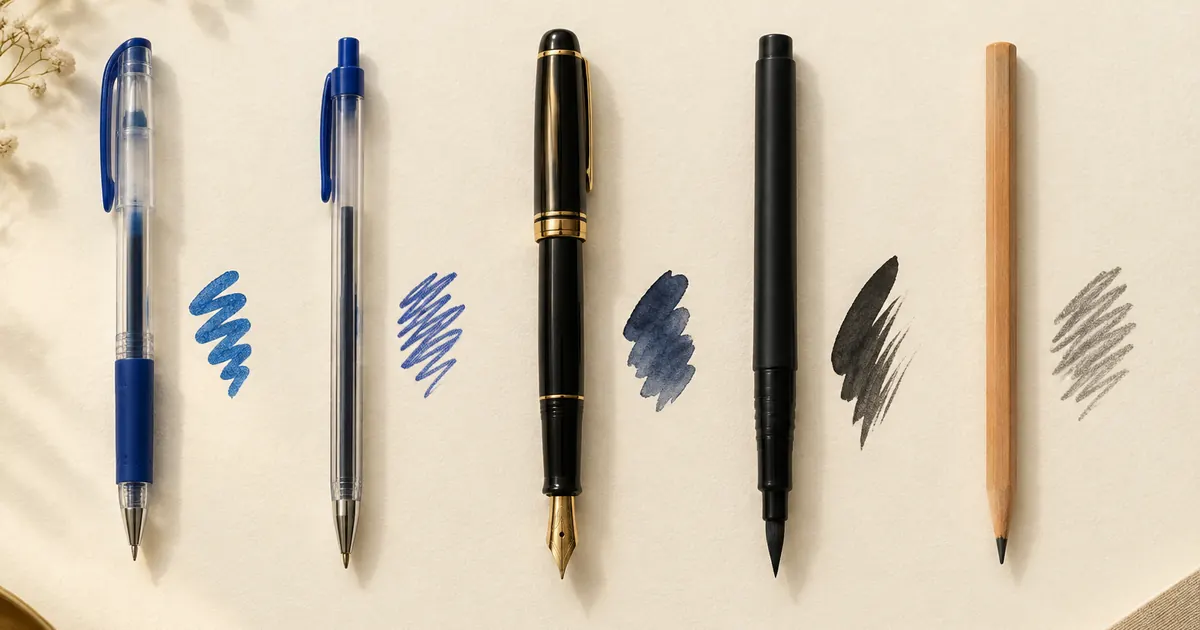
The pen aisle hides a simple truth: there are only four kinds of ink that matter, and each one is best at a different job. Matching the pen to the job — not to the hype — is the whole game. Here is the honest comparison.
Gel Pens: The Everyday Best
Gel ink is pigment suspended in a water-based gel — which is why it writes smoother than ballpoint at a fraction of fountain pen fuss. The trade-off has always been dry time, which is why quick-dry formulations matter: a set of 0.5mm quick-dry gel pens writes crisp lines that left-handers can cross without dragging a mirror image through the page. Gel is the right answer for planners, journals, and anything with colored ink coding — the five-color set covers a week of margin notes.
Ballpoint: The Reliable Workhorse
Ballpoint ink is oil-based paste — thicker, slower, and nearly immortal. It writes on glossy receipts, carbon copies, and damp paper where gel refuses. It never leaks in a bag and survives years in a car door. The trade: you feel the ball rolling, and the line is thinner and less vivid than gel. Keep one on your keychain and one in the glovebox; the Pens & Writing Supplies collection covers the finer points while ballpoint handles the parking garage.
Fountain Pen: The Ritual Purchase
A fountain pen is less a tool than a relationship: ink choice, nib width, the slight pressure learning curve — and in exchange, a writing feel no ballpoint matches. The critical partner is paper: fountain pen ink feathers on cheap paper and shines on dense, 120gsm stock like the ivory pages in our cream hardcover notebook. If your handwriting deserves a hobby, start with a fine nib and a converter; if you write to live rather than live to write, the gel pen is honestly the better marriage.
Brush Pens: The Expression Tools
Brush pens are for letters that perform — card envelopes, journal headers, the satisfying thick-to-thin stroke. A brush pen duo (fine tip for letterforms, broad for fills) covers the lettering spectrum. They demand practice and the right paper, and they reward both: no other pen turns an envelope into an event. Keep them for occasions; let the gel pens handle Tuesdays.
The Pencil Honorable Mention
Graphite deserves its seat at the table: erasable, shadeable, and the only tool that improves with a dust-free eraser alongside it. A 12-grade set in a tin spans hard 4H planning lines to soft 6B sketching shadows. Pencils are the honest tool for crossword, sudoku, and any margin note you might regret.
The Quick Decision Table
- Planner and journal: quick-dry gel, 0.5mm — color-coding without smudges.
- Pockets and cars: ballpoint — indestructible.
- Good paper, good handwriting: fountain pen on 120gsm — the ritual.
- Envelopes and headers: brush duo — the performance.
- Crosswords and sketches: graphite — the honest eraser.
Match the ink to the moment, and every pen in the cup earns its place.
How Ink Dries (and Why It Matters)
Pen complaints reduce to one variable most people never name: dry time. Ballpoint's oil paste dries in under a second — which is why it smears never and feels stiff always. Gel's water base takes one to three seconds in standard form, which left-handers feel as mirror ink on the knife-edge of the hand. Quick-dry gel formulations close that gap to near-ballpoint speed while keeping gel's smooth color. Fountain pen ink dries slowest and depends entirely on paper — on absorbent stock it sets fast; on the 120gsm ivory in our cream notebook, it sits up beautifully for shading but needs the respect of a careful hand. Match dry time to your hand position and the "smudge problem" disappears from your life entirely.
The Lefty Factor
Roughly one writer in ten drags their hand through every line they write, and pen marketing ignores them. The honest advice: quick-dry gel is the lefty's daily answer — the 0.5mm quick-dry set is tested against the sideways-hand grip specifically. Ballpoint works too, at the cost of some smoothness. Fountain pens are the hardest case: fine nibs on fast paper can work, but the lefty fountain pen life is a hobby in itself. Brush pens, mercifully, are used for display lettering where dry time is rehearsal time.
Building a Small Pen Cup That Covers Everything
The mature pen cup holds four instruments, not forty: the daily gel (color-coding, journals, planner), one ballpoint (receipts, garage, lending), the fountain pen for good paper moments, and one pencil for the erasable life. A bamboo holder with five compartments keeps them sorted without turning the desk into a stationery store. The rest of the collection — highlighters, the brush duo, the graphite tin — lives in a drawer, rotated in when the work calls for them. Tools in rotation stay tools; tools in piles become clutter.
Ready to write?
Every piece mentioned ships free in the USA with transparent pricing.
Shop Notebooks & Journals Shop Pens & Writing