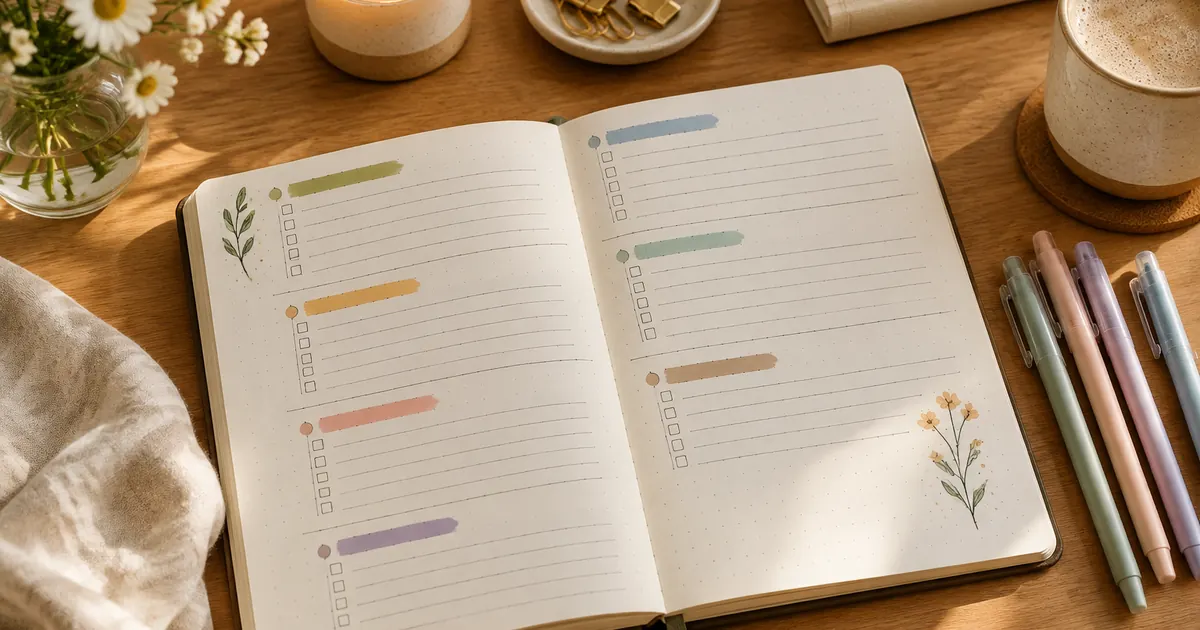
Every failed journaling attempt starts the same way: January 1st, a beautiful new notebook, three pages of soul-searching per day. By January 20th the notebook joins the drawer of abandoned beautiful notebooks, and the guilt makes starting again feel worse than not starting. The fix is not discipline — it is designing the habit to survive your actual life.
Pick the Notebook That Removes Friction
The right journal is the one with no rules attached. A dotted hardcover journal is the most forgiving canvas — dots guide your writing and sketches without imposing lines, so a bad day becomes a list instead of a failure to fill paragraphs. If you prefer structure, a lined notebook in cream paper keeps entries tidy without effort. Either way: hardcover (it survives being written in on your lap), a ribbon marker (no flipping to find your place), and paper that takes your favorite pen without ghosting — because a pen that skips is a reason to quit that has nothing to do with the habit.
The Two-Minute Entry
The habit research is clear: consistency beats depth. A journaling habit survives on entries that take two minutes, not twenty. The template that works: one line about the day, one line about tomorrow. That is the whole system. On good days it will naturally grow into pages; on terrible days, "Day was hard. Tomorrow: call the dentist." still counts — and counts more, because it kept the chain alive. The abandoned journals all died of ambition; yours survives on minimum viable honesty.
Anchor It to Something You Already Do
New habits stick to old ones. Attach the journal to an existing moment: the first coffee (journal sits on the mug's coaster the night before), the last email of the workday (close the laptop, open the notebook), or the bedside table (last thing before lights out). The physical placement matters more than the time of day — a journal visible from where you already sit gets used; a journal in a drawer gets a drawer's worth of attention.
What to Write When You Don't Know
Blank-page paralysis is real, so steal these starters:
- The day in one sentence — what actually happened, not what was planned.
- One thing I noticed — a detail, a conversation, a thing on the walk.
- One thing I want from tomorrow — a single priority, not a list.
On Sundays, look back at the week's entries and circle one moment worth remembering. That is the compounding magic of journaling: not the writing, but the re-reading — a calendar that remembers how it felt.
The Tools That Make It Pleasant
Pleasant tools are not vanity; they are the difference between an open notebook and a closed one. A set of quick-dry gel pens covers color-coding without smudges; a graphite set in a tin earns its desk space when entries turn to sketches. Keep the pen on the journal — a habit with a search step is a habit with an exit ramp. And light the desk the way you would a table you enjoy sitting at: a candle from the Candles & Decor Gifts collection turns two minutes of writing into a small evening ritual rather than a task.
Permission Slips (Read These Twice)
- Skipping days is normal. The habit is returning, not never leaving. An entry that starts "Back after two weeks" is a success story.
- You may not re-read some entries. The writing did its job the day you wrote it.
- The notebook may end up messy. Messy pages are proof of use; pristine pages are proof of nothing.
Start tonight: two lines, the pen left on the page, the journal on the pillow if you have to. Future you — flipping back through a year of days next October — will be glad you did.
Choosing Your Journaling Style
Once the two-minute habit holds for a month, you will discover which direction your entries naturally lean — and there are four honest styles. The log keeper records what happened, a diary of days that becomes surprisingly precious at year's end. The thinker works problems out in prose, using the page as a cheap therapist with perfect confidentiality. The list maker fills pages with favorites, gratitudes, and books read — the scrapbook-adjacent style that future-you will browse like a museum. The planner blends yesterday's review with tomorrow's intentions. None is the "right" way; the right way is whichever you actually do. Most people are a blend of two, discovered by accident around entry thirty.
The Paper Question, Settled
Journaling veterans argue about paper the way cyclists argue about drivetrains, and the honest summary is shorter than the arguments. Ink-friendly paper (120gsm, ivory, dense) means your gel pens stay crisp, your fountain pen stays put, and last week's page does not ghost through this week's. Binding matters more than size: lay-flat construction means the pen never fights the page curve. A5 hits the portability sweet spot — big enough for real sentences, small enough that a full page does not feel like homework. The Notebooks & Journals collection exists because we tested this argument properly, so you can skip the forum threads.
When Life Interrupts (It Will)
Every journaling habit meets the three-week wall: travel, illness, a deadline that eats the evenings. Plan for the interruption instead of being surprised by it. The travel protocol: the journal comes along, but the standard drops to one line per day — written in airports, hotel lobbies, wherever. The recovery protocol: when you return, do not backfill. Start on today's page with a single sentence about the gap, and continue. The journal that records "Two weeks of chaos — back now" is more honest than any reconstructed diary, and honesty is the entire product.
Ready to write?
Every piece mentioned ships free in the USA with transparent pricing.
Shop Notebooks & Journals Shop Pens & Writing