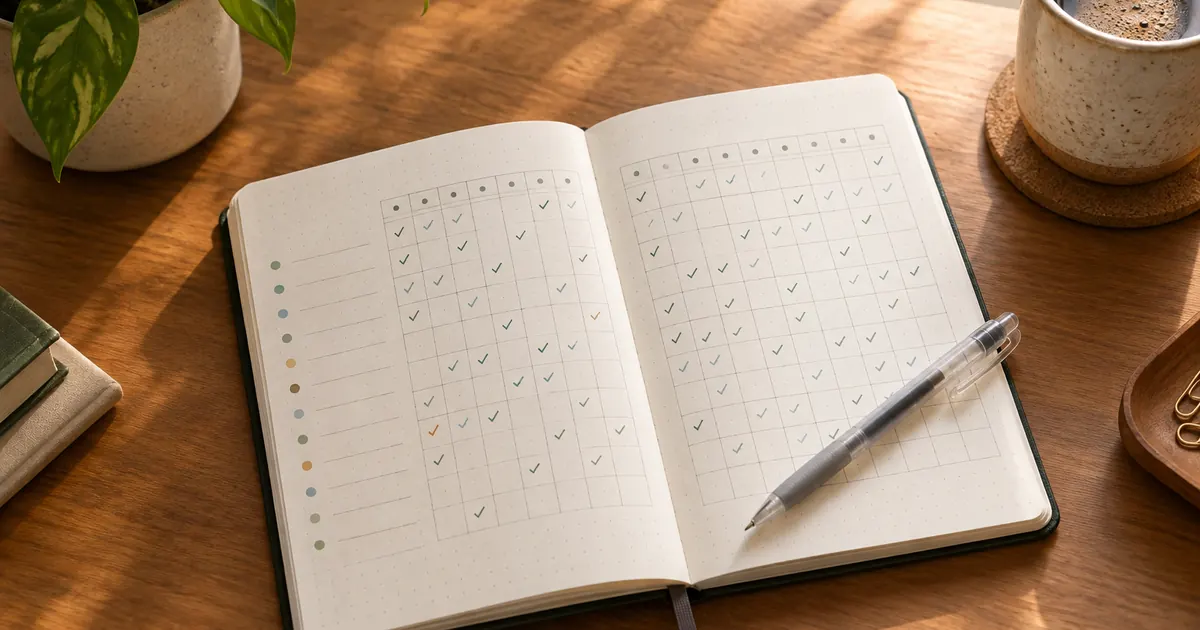
The habit tracker is the most honest page in any journal: a grid of days, filled or not filled, no prose to hide behind. That honesty is also why most trackers die by February — they record failure as vividly as success. The trackers that work are designed differently, and the design starts before the first checkmark.
Track Four Habits, Not Fourteen
The beautiful fourteen-habit spreads online are aspirational art. Behavioral research and the lived experience of every abandoned tracker agree: four habits is the honest maximum, and two to three is where most people succeed. Choose habits that are specific and small — "read 10 pages" beats "read more," "stretch after coffee" beats "get flexible." A dedicated habit tracker journal with pre-printed grids removes the setup friction entirely: open to the month, write your four, start checking.
The Never-Miss-Twice Rule
Missing a day is data, not failure — everyone gets sick, travels, or simply forgets. The rule that keeps trackers alive: never miss twice. One empty box is an accident; two is the beginning of a new (worse) habit. The grid itself helps here — an unbroken chain of checkmarks is genuinely motivating, and a single gap does not break the chain's pull. The visual streak is the entire psychology of the tracker; protect it with the rule, not with guilt.
Make the Checkmark Easy to Earn
If a habit's minimum is twenty minutes, the tracker becomes a to-do list of failures. Set the checkmark bar at the smallest version that still counts: one page of reading, two minutes of stretching, one paragraph of the book you are writing. You will often do more — but the checkmark is for the minimum, and the minimum is always available even at midnight. Habits compound on showing up, not on daily heroics.
The Weekly Review (Five Minutes, Sundays)
Once a week, look at the grid and ask two questions: Which habit was easiest to keep, and why? (Its cue is strong — copy that cue to the harder habits.) Which habit did I resist, and is it the right habit? (Resistance is sometimes a signal the habit is wrong for this season of life — replace it rather than force it.) This review is where trackers stop being scorecards and start being instruments. A daily planner with an hourly layout pairs naturally here: the tracker says what to protect, the planner finds the hour to protect it in.
Stack It Somewhere Real
The tracker page needs a physical anchor: journal open on the nightstand, pen resting on the grid, next to the evening candle if your ritual includes one. The sequence — sit, light, check, write one line, close — takes ninety seconds and becomes its own small pleasure. Habits survive on pleasure longer than on discipline; the warm desk is not decoration, it is infrastructure.
When the Grid Fills In
At month's end, count the checkmarks, notice nothing, and turn the page. The numbers matter less than the month of evidence — you are someone who does these things now, which was the entire point. The Notebooks & Journals collection keeps the next month's grid one free-shipping order away.
Designing the Grid That Suits You
Tracker grids come in three honest shapes. The classic monthly grid — habits down the side, days across the top — suits routine-shaped habits and gives the satisfying chain. The weekly column suits people whose weeks vary: habits down the side, seven columns, one page per week, less commitment per spread. The loop tracker — a circle divided into days — suits the visually motivated and the bullet journal curious. The dedicated habit tracker journal prints all three styles across its undated pages, which removes the last excuse: the grid that fits your brain already exists, waiting, no ruler required.
What the Research Actually Says
Two findings from habit science are worth stealing. First, cue consistency beats reward consistency — habits anchored to the same time and place ("after coffee, at the desk") form faster than habits anchored to motivation. The tracker's job is making the cue visible: journal open on the pillow, grid facing up. Second, self-recorded tracking itself improves behavior — the act of marking a box, independent of any streak, keeps the habit in attention. This is why a paper grid outperforms an app for many people: the hand remembers what the phone forgets. The tracker is not measuring your discipline; it is the discipline, wearing a spreadsheet's clothes.
The Quarterly Audit
Every three months, run the honest review: which habits have become automatic (they feel strange to skip), which still cost willpower, and which died quietly weeks ago. Automatic habits graduate — stop tracking what no longer needs tracking, and use the freed row for the next small habit. Willpower-costing habits get redesigned smaller, not abandoned: "read 10 pages" becomes "read one page" until the checkmark is un-ignorable. Dead habits get replaced without ceremony — the tracker's job is honest data, and the data said this habit was not the season's work. The hourly planner pairs with the audit: graduated habits get their protected hour, and the system compounds.
Ready to write?
Every piece mentioned ships free in the USA with transparent pricing.
Shop Notebooks & Journals Shop Pens & Writing