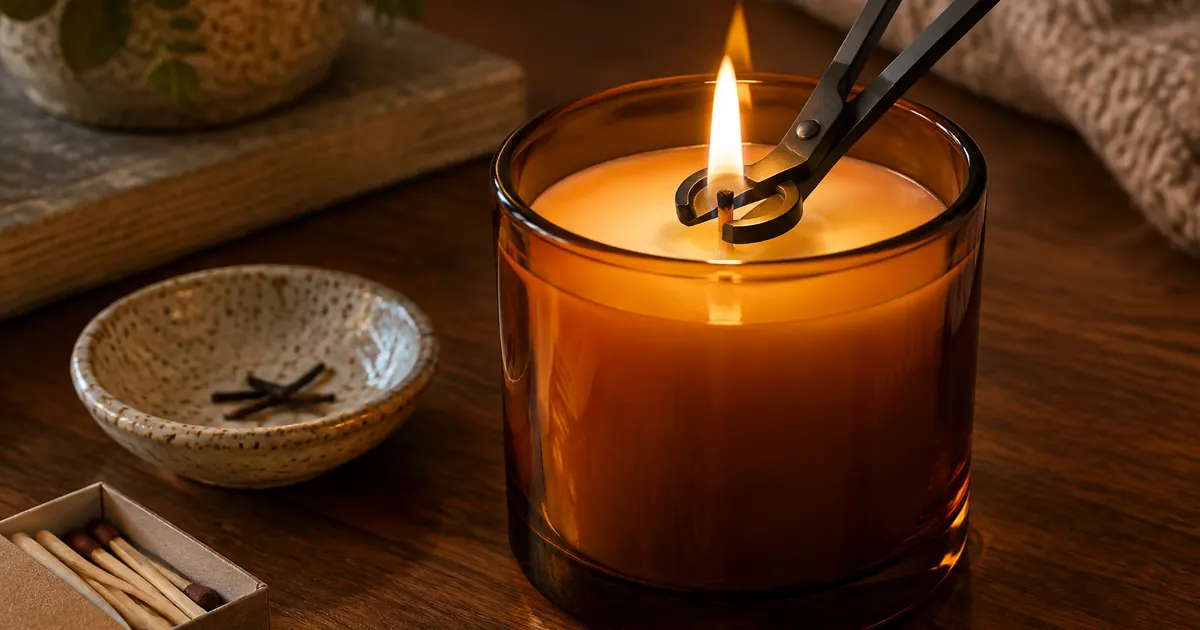
A good soy candle is a small investment in an evening — and like most investments, it rewards five minutes of technique with twice the lifespan. Candle care is not precious; it is four habits that prevent the tunneling, soot, and weak scent that waste candles. Here is the complete guide.
The First Burn Is the Most Important
Wax has memory. On its first burn, a candle melts outward as far as it will — and if you extinguish it before the melt pool reaches the jar's edge, the candle remembers: every future burn follows that same ring, creating the dreaded tunnel (a hole down the middle with walls of wasted wax). The rule: first burn, one to two hours, melt pool to the edge. Light it when you have an evening at home, not before a quick errand. A soy candle in an amber jar rewards the patience — soy wax burns slower and cleaner than paraffin, so the first burn's full pool sets up weeks of even burning.
Trim the Wick, Every Single Time
Before every burn — every one — trim the wick to about 5mm (a quarter inch). Long wicks create tall flames, and tall flames create soot, smoke, and wax that burns faster than it should. A wick trimmer (or nail clippers, honestly) takes ten seconds; the ceramic dish of trimmed wicks becomes a small ritual of its own. Trimmed candles burn slower, smell cleaner, and never leave the gray film on jar glass that untrimmed ones do.
Where Candles Burn Best
Location changes candle behavior more than most people expect. Drafts (doorways, windowsills, active hallways) make flames flicker and burn unevenly — one side of the wax melts while the other walls up. Burn candles on stable surfaces away from moving air, and keep them out of direct sunlight between burns (UV fades wax and scent). A candle on the organized desk or beside the evening reading chair earns its keep; a candle on a windowsill decorates its own funeral.
Fixing a Tunnel (If It's Already Late)
Already tunneled? Two rescues, in order of effort. The foil method: light the candle, cover the top with foil, and cut a small hole over the flame — the trapped heat melts the raised walls back level within an hour or two. The full-pool reset: burn the candle for a long, supervised session until the pool reaches the edge again. What does not work: digging wax out with a spoon (ruins the wick) or microwaving the jar (do not). Rescue works once or twice; the trim-and-first-burn habits prevent the need entirely.
Safety, Briefly and Seriously
- Never burn past half an inch of remaining wax — the jar overheats.
- Keep flames away from anything that isn't the candle — a ceramic mug of coffee is fine company; a stack of paper is not.
- Extinguish with a snuffer or the lid, not by blowing (blowing scatters wax and smoke).
- Never leave a burning candle with a pet or child in the room.
The Evening Ritual, Assembled
Trim, light, and let the first burn do its work while you read or write — the dotted journal and a lit candle are the oldest productivity system there is. When the jar is finally empty, the amber glass makes a pen cup with a rinse. The Candles & Decor Gifts collection keeps the next evening one free-shipping order away — and the candle-and-mug gift set is how most people accidentally start this whole ritual.
Scent Throw: Hot vs. Cold
Candle shopping happens cold — sniffing jars in a shop or unboxing one at home — but cold throw and hot throw are different products. Cold throw is the scent's promise; hot throw is the delivery, and it depends on melt pool size and wax chemistry. Soy wax carries fragrance more gently than paraffin — which is why a soy candle in amber glass scents a room softly rather than announcing it. The practical expectation: a quality 200g soy candle fills a study or bedroom within an hour; an open-plan living space wants two, or one burned near where you sit. Scent that "disappears" after ten minutes is nose adaptation, not failure — step outside for a minute and the room will prove itself.
The Candle's Life Expectancy
Honest numbers for planning your ritual: a 200g soy candle with a trimmed wick and disciplined two-to-three-hour burns delivers roughly 35–45 hours of light. The tunneling casualty delivers 15 — the same candle, half the evenings, purely a care difference. Track it the way you would any small pleasure budget: burn sessions in the evening planner page, wick trimmed the night before, and the candle becomes a month of deliberate evenings rather than three chaotic weeks. When the jar reaches its half-inch of remaining wax, retire it — the final burns overheat the glass, and the jar's second life as a pen cup or desk organizer begins.
Gifting Candles (the Care-Aware Way)
Candles are the most-gifted and least-instructed present — which is why so many gifted candles tunnel tragically by March. The fix is one line of instruction with the ribbon: "Trim the wick before each burn, and let the first pool reach the edge." Attach a card from the boxed greeting card set with that line and a personal sentence, and the gift arrives with its own manual. The candle-and-mug set solves the packaging half; the card line solves the care half — and the recipient's February self will know who to thank.
Ready to write?
Every piece mentioned ships free in the USA with transparent pricing.
Shop Notebooks & Journals Shop Pens & Writing